
By KMedTrip editorial · Updated · Written with AI assistance · Reviewed by KMedTrip native-speaker review team
This guide is general information, not medical advice. KMedTrip is run by a government-registered foreign patient facilitator (an agency that helps international patients arrange medical care). We do not recommend, rank or receive payment from any hospital or clinic.
After a dental or cosmetic procedure, eating can feel awkward. Your mouth or face may be swollen. You may have stitches. And the menus are in Korean.
The good news: Korea has many soft, mild foods that are easy to find. This guide gives general ideas. Always follow the written aftercare instructions from the medical team that treated you. Aftercare means the care you give yourself while you heal. Your team knows your procedure and may give rules that differ from this list.
Key takeaways
Do these steps a day or two before your procedure day.
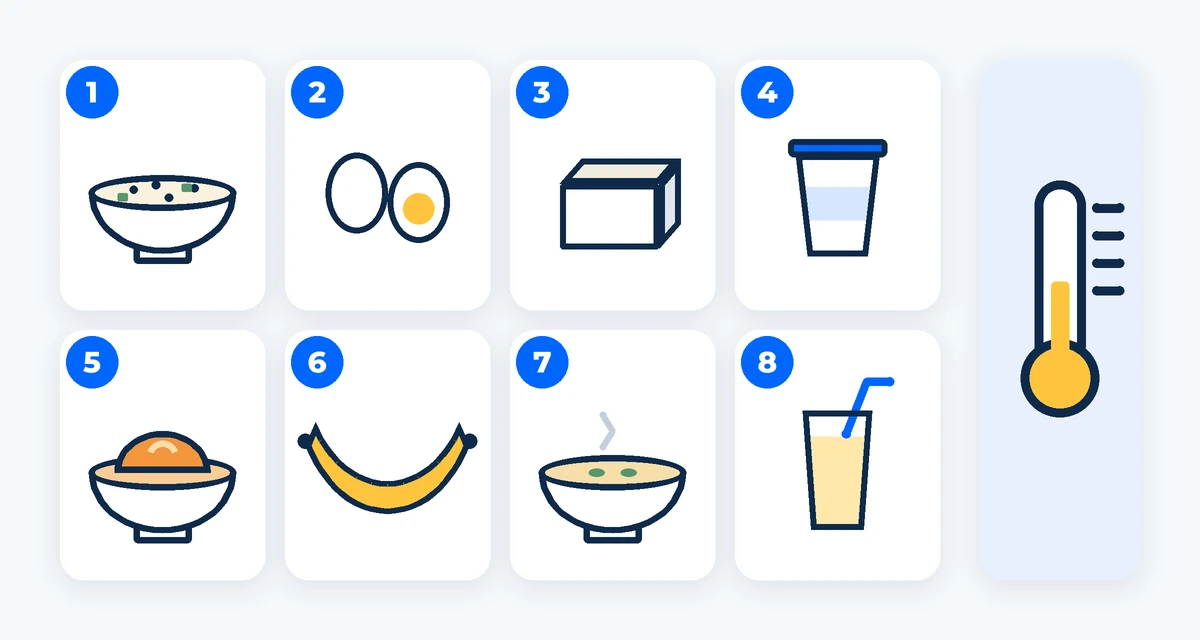
Figure 1. Soft foods that are easy to find in Korea. ① Rice porridge. ② Soft or steamed eggs. ③ Tofu. ④ Yogurt. ⑤ Mashed sweet potato or pumpkin. ⑥ Bananas and soft fruit. ⑦ Soups cooled to warm. ⑧ Smoothies (check with your clinic about straws).
After a tooth is removed, the UK NHS advises eating soft or liquid food until you can chew more comfortably (NHS, accessed October 2026). Soft food is also often easier after face, jaw or nose procedures. Opening your mouth wide or chewing hard can be uncomfortable then.
Easy soft options in Korea include:
Lukewarm means just a little warm, not hot. It is often better than hot in the first days. This matters most if your mouth is numb or sore. A numb mouth cannot feel heat well, so it is easy to burn yourself.
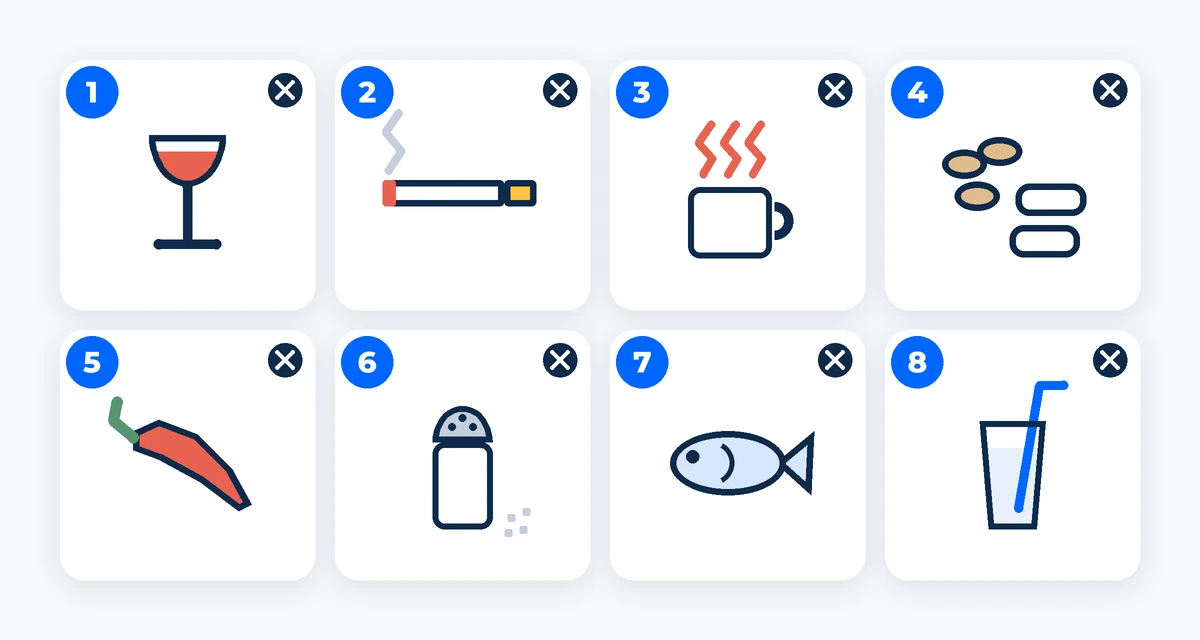
Figure 2. Common things to avoid while healing. ① Alcohol. ② Smoking and vaping. ③ Very hot food and drinks. ④ Hard, crunchy or sticky food. ⑤ Very spicy food. ⑥ Very salty food. ⑦ Raw or undercooked food. ⑧ Straws, if your clinic advises.
Your clinic’s list may be longer or shorter. Common advice includes:
| Avoid | Why |
|---|---|
| Alcohol | The NHS advises not drinking alcohol after tooth removal, to lower the risk of bleeding. Alcohol can also interact with (change the effect of) pain medicines and antibiotics. The NHS advice on cosmetic surgery abroad also says to avoid alcohol after surgery. Many clinics ask you to avoid it for longer. |
| Smoking and vaping | The NHS notes smoking can raise the risk of infection after tooth removal. Smoking is also widely linked with slower wound healing. |
| Very hot food and drinks | These can cause bleeding or burns after dental work. |
| Hard, crunchy or sticky food | Nuts, seeds, chips, crusty bread and chewy rice cakes (tteok) can hurt a wound or get stuck in it. |
| Very spicy food | Many Korean dishes use red pepper paste or flakes. Spice can sting a healing mouth. |
| Very salty food | Many people are told to keep salt moderate while swelling settles. Korean soups and stews can be salty, so leave some of the broth. |
| Raw or undercooked food | Avoid it from places you are unsure of. The US CDC’s advice on medical tourism highlights infection as a key risk. A stomach upset slows your recovery. |
| Straws | Avoid them if your clinic tells you to. This is common after tooth extraction. |
If you take prescribed medicines, ask whether to take them with food. Also ask whether any food or drink should be avoided.
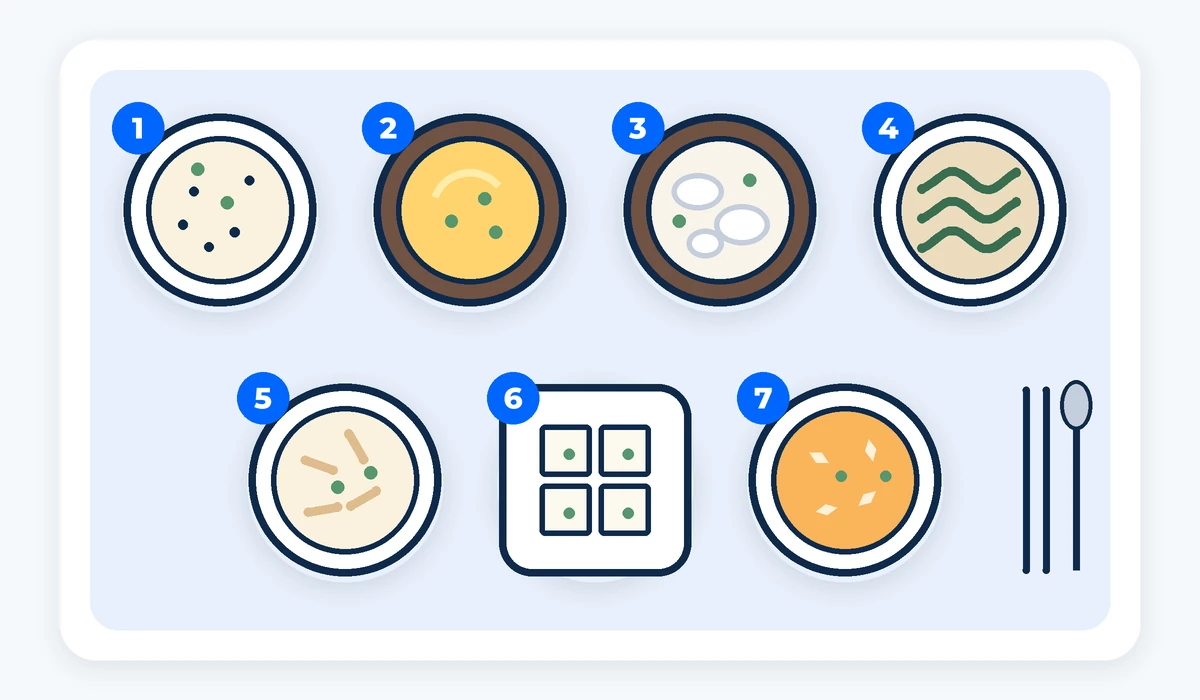
Figure 3. Gentle Korean dishes. ① Juk (rice porridge). ② Gyeran-jjim (steamed egg). ③ Sundubu (soft tofu), ordered mild. ④ Miyeok-guk (seaweed soup), cooled. ⑤ Dakjuk (chicken porridge). ⑥ Dubu (plain tofu). ⑦ Hobak-juk (pumpkin porridge).
These dishes are common, mild and usually soft. To be safe, ask for them “not spicy” (an maepge, 안 맵게).
| Dish | What it is | Tip |
|---|---|---|
| Juk (죽) | Rice porridge. The Korea Tourism Organization says Koreans eat porridge when unwell because it is easy to digest. | Types include vegetable (yachae-juk), pumpkin (hobak-juk), pine nut (jat-juk), abalone (jeonbok-juk) and beef and vegetable. |
| Gyeran-jjim (계란찜) | Soft, fluffy steamed egg | Often served as a side dish. Let it cool. |
| Sundubu (순두부) | Very soft tofu | The stew is often spicy. Ask for a mild version. |
| Miyeok-guk (미역국) | Mild seaweed soup | Traditionally eaten after childbirth and on birthdays. Let it cool. |
| Dakjuk (닭죽) | Chicken porridge | Or the cooled broth from samgyetang (chicken soup). |
| Dubu (두부) | Plain tofu | Choose steamed or lightly pan-fried, not spicy. |
| Hobak-juk (호박죽) | Pumpkin porridge | Slightly sweet. |
Porridge shops are found in most neighborhoods. Many offer delivery.
Show these to staff or type them into a delivery app note:
Delivery apps let you order porridge to your accommodation. This helps when you do not want to go out with swelling or bandages. Some apps now support visitors. For example, Baemin (Baedal Minjok), a large Korean delivery app, announced in May 2026 that it accepts foreign-issued Visa, Mastercard, JCB and American Express cards through Apple Pay. It also offers English, Chinese and Japanese service (company announcement reported by The Korea Times, 31 May 2026).
Many other Korean apps only accept Korean-issued cards. Before your procedure, test that you can order and pay. See our guide on money and payments in Korea.
Many Korean dishes use pork, meat broth or cooking wine. If you eat halal, plan ahead.
The Korea Tourism Organization (KTO) sorts Muslim-friendly restaurants into four groups (VISITKOREA, accessed October 2026):
| Group | What it means (per KTO) |
|---|---|
| Halal Certified | Certified by an accredited halal certification agency, such as the Korea Muslim Federation (KMF). |
| Self Certified | All food is halal. The Muslim owners certify it themselves. |
| Muslim Friendly | Some halal dishes are served. Alcohol may be sold. |
| Pork-free | No halal menu, but no pork is used. Alcohol may be sold. |
Step by step:
Useful phrases from Visit Seoul:
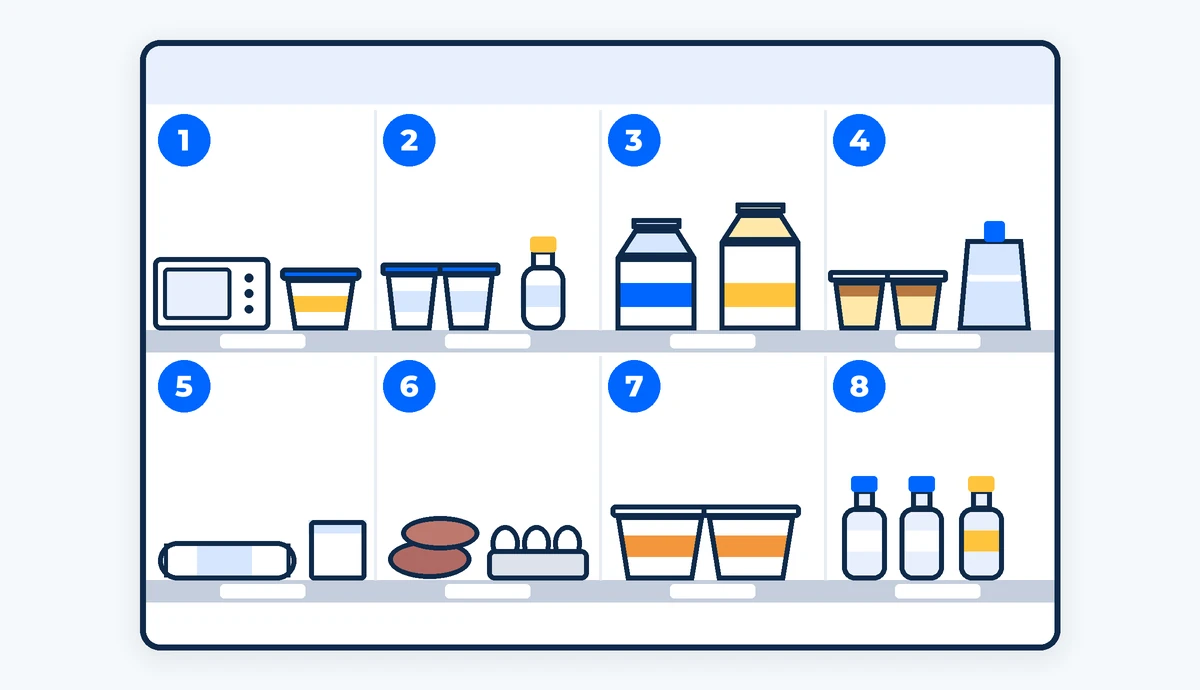
Figure 4. Soft options at a Korean convenience store. ① Ready-to-eat porridge. ② Yogurt and drinking yogurt. ③ Flavored milk and soy milk. ④ Puddings and jelly drinks. ⑤ Soft tofu packs. ⑥ Steamed sweet potato and boiled eggs. ⑦ Instant soups (check the spice level and let them cool). ⑧ Water and electrolyte drinks.
Korean convenience stores are on most streets. Many are open late, often 24 hours. Useful soft items include:
Contact the medical team that treated you if you have:
In an emergency in Korea, call 119. For travel questions in your language, the 1330 Korea Travel Hotline (+82-2-1330 from a foreign phone) can help in Korean, English, Japanese, Chinese, Russian, Vietnamese, Thai and Malay (VISITKOREA, accessed October 2026).
How long should I eat soft food? It depends on your procedure. Follow your clinic’s written aftercare sheet. Ask how long each food rule lasts.
Can I drink coffee or tea? Very hot drinks can cause bleeding or burns after dental work. Let drinks cool to lukewarm, and ask your clinic about caffeine.
Can I use a straw for smoothies? Ask your clinic first. Avoiding straws is common advice after tooth extraction.
How do I order food that is not spicy? Say or show “안 맵게 해 주세요” (an maepge hae juseyo), which means “Not spicy, please.”
Is Korean porridge easy to find? Yes. Porridge shops are in most neighborhoods, and convenience stores sell ready-to-eat porridge you can heat.
How do I find halal food? Use the Korea Tourism Organization’s official search for Muslim-friendly restaurants. Look for the “Halal Certified” group if you only eat certified food (VISITKOREA, accessed October 2026).
When should I call for help? Contact your clinic for bleeding that does not stop, worse pain or swelling, fever or signs of infection. In an emergency in Korea, call 119.
If you’d like help planning, you can talk to a coordinator.