By KMedTrip editorial · Updated · Written with AI assistance · Reviewed by KMedTrip native-speaker review team
This guide is general information, not medical advice. KMedTrip is run by a government-registered foreign patient facilitator (an agency that helps international patients arrange medical care). We do not recommend, rank or receive payment from any hospital or clinic.
Many people compare dental implant prices between countries before they choose where to be treated. A dental implant is an artificial tooth root placed in the jawbone, with a new tooth on top. Headline prices can mislead you. One “implant” quote may include much more work than another.
This guide explains:
what goes into the cost,
what public data says about Korea and other countries,
how many trips you may need,
and how to compare quotes fairly.
Key takeaways
An implant quote may or may not include the fixture, abutment, crown, bone graft, scans and follow-up. Always compare item by item.
Korea publishes non-covered dental prices by institution through HIRA. The 2025 and 2026 data showed wide price differences between providers.
In most OECD countries, implants for adults are mostly paid out of pocket, so prices are set by the private market and vary widely.
Implant treatment usually takes months and several visits. Travel, accommodation and time off work belong in your comparison.
What makes up implant cost
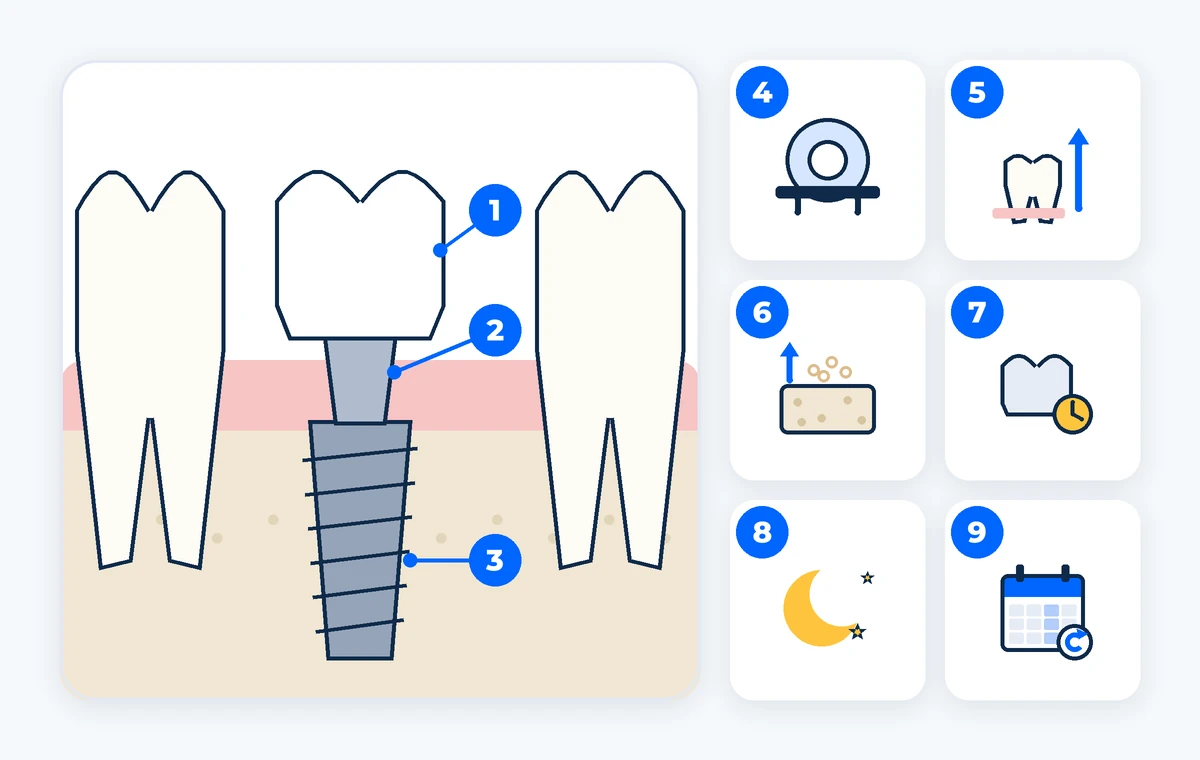
Figure 1. The parts of an implant and the extra costs that may be in a quote. ① Crown. ② Abutment. ③ Fixture. ④ Diagnosis and 3D CT. ⑤ Extraction. ⑥ Bone graft or sinus lift. ⑦ Temporary teeth. ⑧ Sedation. ⑨ Follow-up and maintenance.
The three main parts
A single-tooth implant usually has three parts:
Part
What it is
Fixture
The screw placed in the jawbone. It acts as the new tooth root.
Abutment
The connector between the fixture and the crown.
Crown
The visible tooth. It is made from materials such as zirconia (a strong ceramic) or porcelain fused to metal.
Other costs that may or may not be included
Diagnosis and imaging, such as a 3D CT scan (a three-dimensional X-ray of the jaw).
Extraction (pulling out) of the old tooth.
Bone grafting or sinus lift. These add bone when there is not enough to hold the fixture. A sinus lift adds bone in the upper jaw, below the air space behind the cheeks.
Temporary teeth while you heal.
Sedation (medicine to make you relaxed or sleepy), if used.
Follow-up visits and maintenance, and what happens if something must be redone.
What else changes the price
The brand of implant system.
The crown material.
How complex your case is.
The experience of the treating team.
Two quotes with the same headline figure can cover very different work.
How costs compare across countries
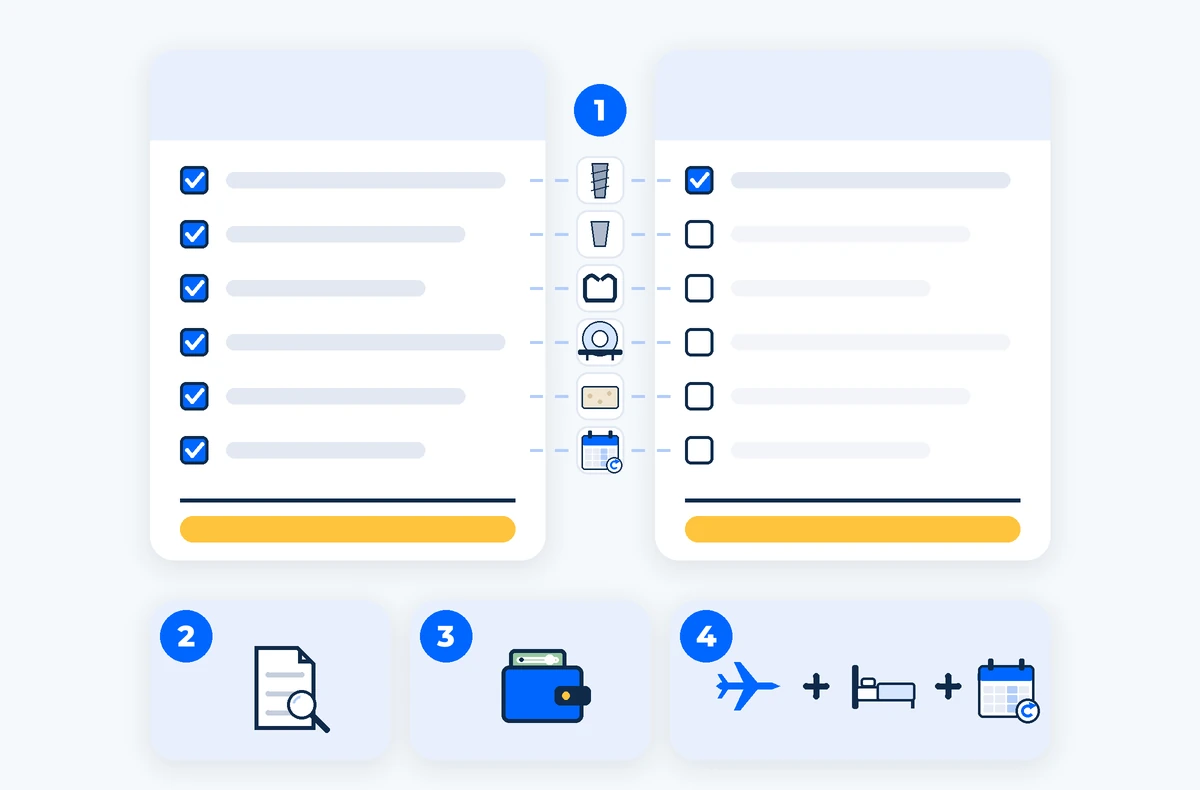
Figure 2. How to compare implant quotes fairly. ① Compare item by item, not the headline price. ② Korea: HIRA publishes non-covered prices by institution. ③ In most OECD countries, implants are mostly paid out of pocket. ④ Add travel, stay and follow-up costs.
Korea: public price data
HIRA (Health Insurance Review and Assessment Service, the agency that reviews medical fees) publishes non-covered prices. “Non-covered” means not paid by Korean national insurance, so the patient pays the full price. Medical institutions report these prices, including implants per tooth.
What the Ministry of Health and Welfare said in its press releases:
3 September 2025: price differences between institutions for implants had increased from the previous year. Dental implants were the largest single non-covered dental item by total spending in the government’s analysis.
3 September 2026: the national average implant price fell by 0.9% from 2025. Prices for 753 non-covered items were published for about 74,000 institutions.
To show the gap, the 2026 release gave an anonymous example for a zirconia implant. One clinic’s median (middle) price was KRW 1.1 million. Another clinic’s maximum price was KRW 1.72 million. The ministry says gaps come from differences in what is included, difficulty, staff and equipment.
This example is public government data. It shows how wide the range can be. It is not a recommendation of any clinic or price.
Korea: national insurance for older residents
Korean National Health Insurance covers implants for insured people aged 65 or older who have lost some of their teeth. It covers up to two implants per lifetime. The patient pays a 30% co-payment (a share of the cost). Registration through a dental clinic is needed before treatment (NHIS, accessed October 2026).
Visitors who are not enrolled in Korean insurance pay the full non-covered price.
Other countries
Reliable, comparable official statistics on implant prices across countries are hard to find. What official sources do show:
OECD. Public coverage of dental care is far more limited than for other health services. Public packages are often limited to children, and cost-sharing is higher. On average across OECD countries, less than one third of dental care costs are paid by government schemes or compulsory insurance (OECD, Health at a Glance 2025).
UK. The NHS says implants are usually only available privately. Exceptions are limited cases, such as after mouth cancer or an accident (NHS, accessed October 2026).
Many other countries. Private clinics set implant prices. Prices vary by city and provider, much like in Korea. Public insurance rules differ a lot by country, so check what your own national scheme or health insurer pays for.
Because of this, we do not publish a country-by-country price table. A single “average price” for a country hides large differences inside that country. Use real written quotes for your own case.
Hidden costs of treatment abroad
The UK NHS (Fit for Travel) and the US CDC advise people to count all costs before treatment abroad. Add these to your comparison:
Cost
Why it matters
Flights
You may need two trips (see below).
Accommodation
Several nights per trip.
Local transport and meals
Every day you stay.
Time off work
Each trip and recovery days.
Contingency
Extra nights if your plan changes.
Follow-up at home
A local dentist may charge to check or fix problems.
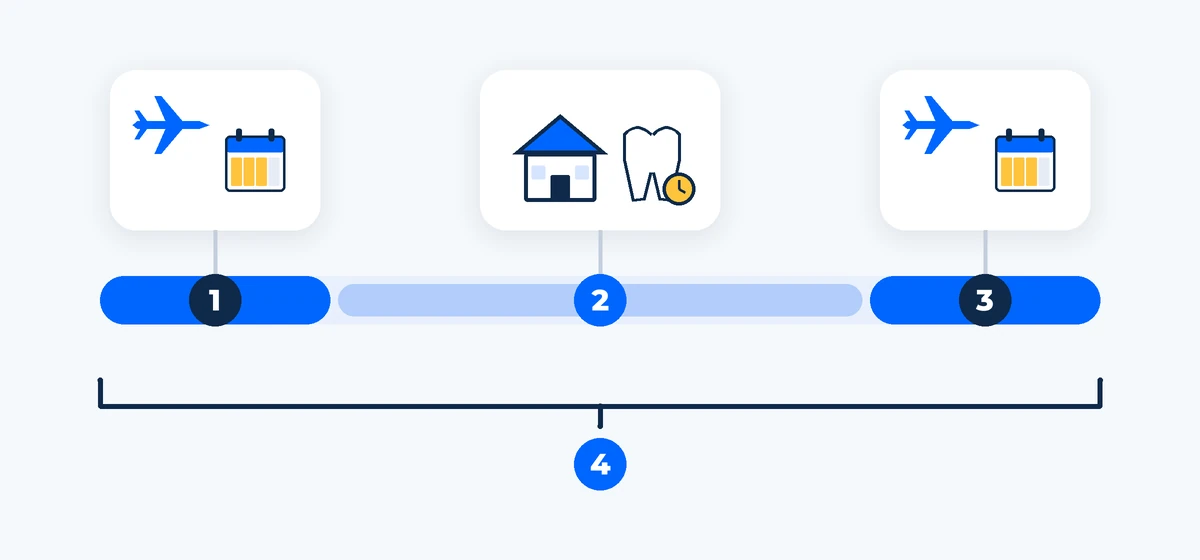
Figure 3. A typical two-trip implant plan. ① Trip 1: consultation, scans and fixture placement. ② Healing at home: at least about 3 months. ③ Trip 2: abutment and final crown. ④ Whole process: usually several months, longer with a bone graft.
Implant treatment is usually done in stages:
Assessment and planning.
Bone grafting, if needed.
Placing the fixture.
Healing.
Fitting the final crown.
A UK NHS hospital’s patient information says you usually wait at least 3 months after the implant is placed before teeth can be fitted. If a bone graft is needed, treatment can take another 4–6 months (Guy’s and St Thomas’ NHS Foundation Trust, accessed October 2026). So the whole process usually takes several months. The NHS also notes that replacement parts take time to prepare, so they may not be ready at your first visit (NHS, accessed October 2026).
What this means for your trips
Stage
What happens
Time
Trip 1
Consultation, scans, extraction or bone graft if needed, fixture placement
At least several days, plus time for stitch removal or a check
Healing at home
The fixture joins with the bone
Usually a few months
Trip 2
Abutment and final crown, with adjustments
May also take several days
Some cases are done faster. Some take longer, for example with bone grafting.
Ask your local dentist if they are willing to see you.
Questions to ask any dentist
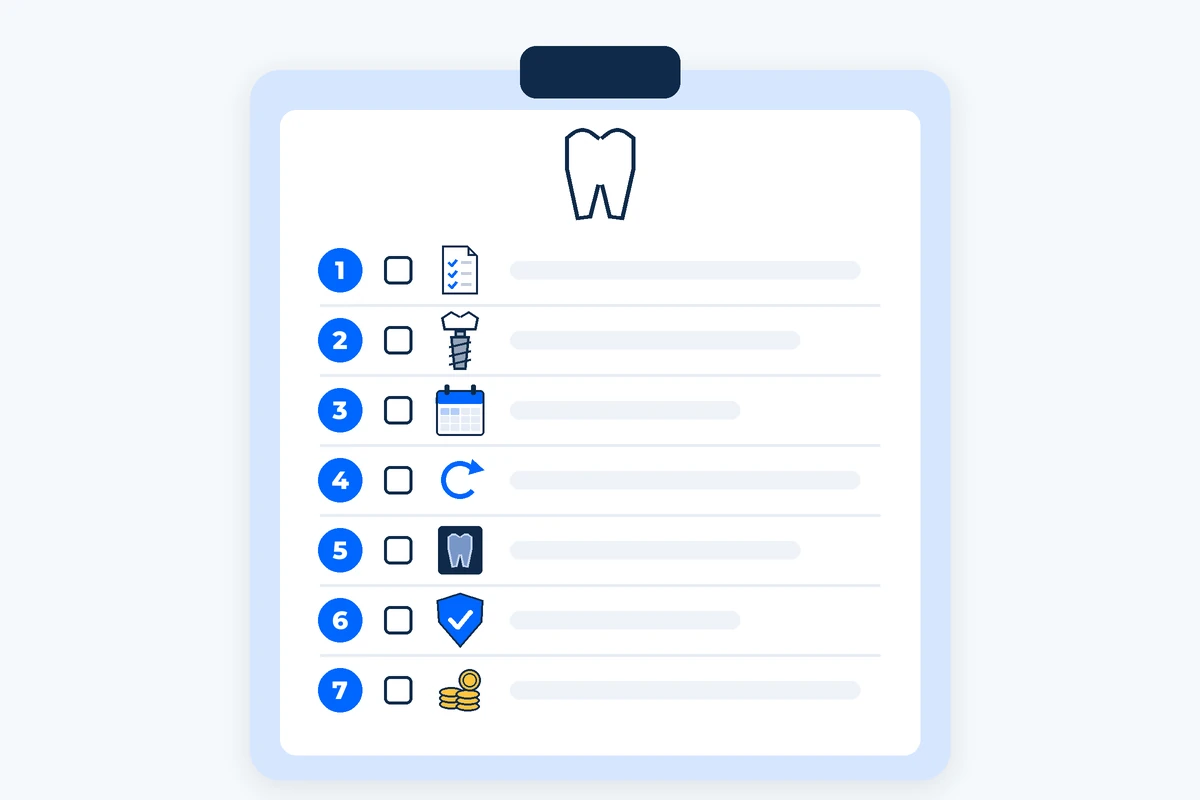
Figure 4. Seven questions to ask before you book. ① What exactly is included? ② Implant system and crown material in writing. ③ Number of visits and stay length. ④ What if it fails or needs redoing? ⑤ Copies of scans and implant details. ⑥ Registered for foreign patients? ⑦ Currency and tax.
These questions are useful in any country:
What exactly is included in this price (fixture, abutment, crown, scans, grafts, sedation, follow-up)?
Which implant system and crown material will you use? Can I get their names in writing?
How many visits will I need? How long must I stay in the country each time?
What happens, and what will it cost, if the implant fails or needs to be redone?
Will I get copies of my scans, records and the implant details to take home?
How much does a dental implant cost in Korea?
There is no single price. HIRA publishes non-covered prices by institution, and the 2026 data showed wide gaps between providers (Ministry of Health and Welfare, 3 Sep 2026). Ask for a written, itemized quote for your own case.
Does Korean national insurance pay for my implant?
Not if you are a visitor. Coverage is for insured people aged 65 or older, up to two implants per lifetime (NHIS, accessed October 2026). Visitors pay the full non-covered price.
Can I get an implant in one trip?
Usually not. The fixture often needs at least about three months to heal, and longer with a bone graft (Guy’s and St Thomas’ NHS, accessed October 2026).
Why do two quotes with the same price differ so much?
One may include only the fixture. Another may include the abutment, crown, scans and follow-up. Compare item by item.
Does travel insurance cover implant problems?
Normal travel insurance usually does not cover planned treatment or its complications. Check your policy carefully.
What should I bring home after treatment?
Copies of your scans, records and the implant system details. Your local dentist may need them later.
If you’d like help planning, you can talk to a coordinator.